
There are still a lot of these around but you never hear much about them. They have been pushed aside by today’s high end APOs, SmartScopes, and all those amazing plate solving mounts. So why do I still have one?
Let’s talk about that for a minute.
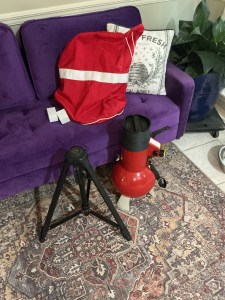
I’ve had my Astroscan for a long time. I don’t really know when or where I got the thing. It was on a whim – I remember that. It came with an original Edmunds tripod ( don’t see these much) and a couple of Edmund’s branded Plossl eyepieces – no original RKEs… Everything in a really nice heavy red canvas tote. Honestly the last time I set the thing up was when I was recovering from a quadruple bypass a decade ago now. It was the only scope I had that met the 10lbs or under post surgery lifting mandate. That little scope was one of the things that kept me getting up. Keep moving. You can read an article I wrote about it here.
Probably 75% of my observing is grab-and-go. I enjoy setting up a scope on the back deck when the opportunity comes along. Dinner will be almost ready and I walk outside to see a gorgeous clear night – I’ve got 10 minutes or so. I grab a small aperture scope on a simple alt/az mount and a couple of eyepieces, set everything on the back deck to let it acclimate. After dinner is done and the dishes are in the dishwasher I go outside and I’m good to go. I like this. My scope and mount must be compact enough to move outside in one trip. This means it’s also easy to move around on the back deck to peek at stuff hiding around the trees. It should have a Field of View of 3 degrees or so – no need for a finder – and it should have enough aperture to show Messier class clusters and, with the help of a UHC filter, reveal some of the brighter emission nebulae. Modest requirements, but I’d rather be looking at a gorgeous night sky with a modest rig than not looking at the sky because my crew-operated Humongo scope would take too long to set up.
If you think about it, the Astroscan fits my requirements nicely…
Well, a couple of days ago I was moving some things around upstairs and ran across the Astroscan. With a big grin I set it to one side and when I was finished I brought it downstairs.
We’ve had really good viewing here in the suburban Southeast lately. The seeing and transparency have been excellent and the low humidity has helped with the light pollution from the surrounding towns. Cloud cover has been minimal and the smoke from earlier in the year has gone. Even the night time temps have cooperated. Cool enough to need a hoody and just cool enough to keep the mosquitos away. Pretty perfect conditions!
So that evening I set the Astroscan up on the back deck just for the fun of it… and it did not disappoint… M35, M36, M37, and M39 early in the evening and NGC457, Double Cluster, M42 and M44 later that night. Saturn, Jupiter, and Mars were not that impressive but they were there. M57 was barely there. A nearly full moon did not help things. But gorgeous Albireo was an easy split. I could not split Almach later that night. The max magnification I get is 30X with the provided 15mm Plossl, with other eyepieces I can go higher but much beyond that and things get murky. The Astroscan was never intended for anything more than wide field viewing and the Moon. It still does those things very well.
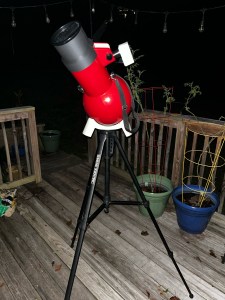
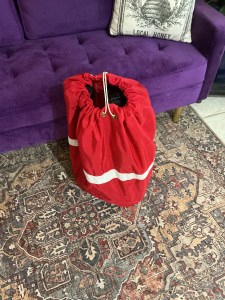
As cute as it was, when I came in for the night I put everything back in its red canvas tote and took it upstairs for storage… for all the nostalgia, there’s just better equipment. On the plus side: the Astroscan’s bowling ball shape make it’s eyepiece movable to any conceivable location. The optics are good. The simple finder works really well. Because of its wide FOV you don’t need to be constantly moving the scope to keep objects in view. The tripod is very stable even in a little wind and the scope stays on target with just enough stiction. The whole thing is lightweight and, like mentioned above, is easy to move to a better spot. There is enough aperture to see A LOT of things. It is robust and kid-resistant and it holds its collimation for decades.
But on the negative side: the stiction also makes its hard to smoothly track an object when you do need to recenter it. The focuser is hard to put a fine touch to ( really all single speed focuser share this… but can be especially irksome at F/4.2). It’s not a good star party scope because people are going to touch your equipment and it too easy to move off of target – you are constantly putting it back on target for the next person. The optics are good… but just good. The finder does works really well but is a straight-through and my back does not do straight-through as well as it used to. As mentioned above, the optics can’t be pushed very hard. The maximum magnfication rule of thumb for telescopes is 50X the aperture of the primary in inches… with the Astroscan it’s more like10X. I found myself using expensive eyepieces to wring out every single photon I could. The included EPs were good enough… but the Naglers, as expected, really helped things along. Not really in the spirit of an economical, no frills telescope. It does hold its collimation for a long time but it’s very difficult to touch up if it ever does need to be re-collimated.
So back in the closet upstairs it went.
For comparison, my most used scope is an original version AstroTech AT 72 ED. It provides beautiful, crisp, wide field viewing and can easily reach 50X its aperture in inches for max magnification – if the atmosphere cooperates. The little APO sits on a manual alt/az mount with smooth slow motion controls that make high power tracking easy. Well, if you call 150X high power. The mount is stable in wind and is a joy to use. I don’t really use a finder since it has a 3.6 deg FOV. You can get more FOV but you’ll have to rebalance constantly to allow for much heavier eyepieces. My low power is an older two inch 20mm Nagler type 5 and I use a weighted brass 2/1.25 adapter for my 1.25” eyepieces. Balance is good.
The last thing I’ll mention is exit pupil. My ancient eyes will open up to a little over 5mm and this limits me for low power eyepieces in fast scopes. The Astroscan’s F/4.2 with its provided 28mm Plossl yields and exit pupil of 28/4.2 = 6.7mm which means I’m going to see the shadow of the secondary. Especially when I’m on the back deck where the ambient light never really lets my eyes fully dilate. The little AT72ED operates at a more forgiving F/6 so I can even use my massive 31Nagler and not have any wasted light – 31/6 =5.167mm.
So… why do I keep the AstroScan?
Because it’s one of most fun scopes I’ve ever used. It makes me smile and it makes everyone smile who walks up to it on the observing field when I take it to a dark spot on a club night. Even the younger folks and kids who have never seen its unique red shape love it. You are drawn to it; you have to look at and through the thing.
I’m downstairs now but after supper I’m going upstairs and take it out of its tote and set it on the coffee table in my office. It should be admired more often. And when the nostalgia kicks in… 🙂
Fred
October 24th, 2026


Leave a Reply